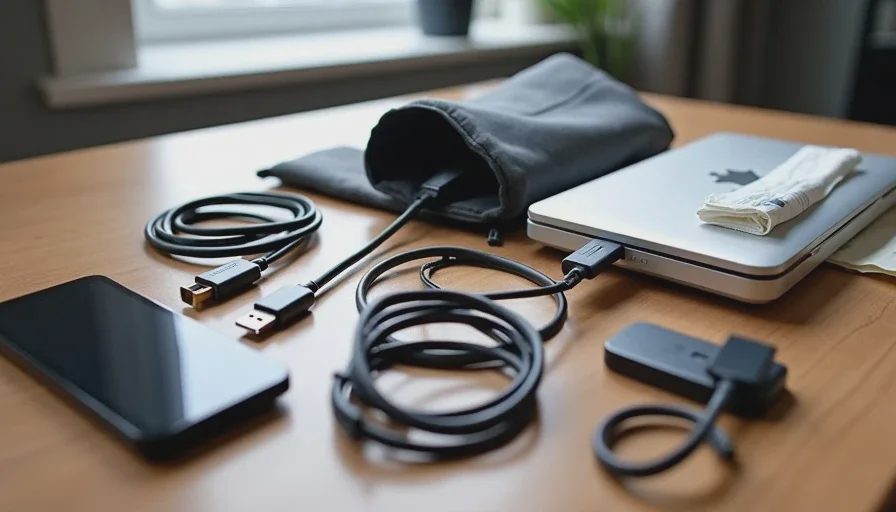
Here's the short answer: your tech pouch becomes a cable graveyard because it has no structure, no size limit, and no regular emptying ritual. The fix is three things—a pouch with elastic loops instead of open pockets, a rule that nothing goes in unless it has a purpose, and a two-minute weekly reset. Do that and your pouch stays useful for years instead of becoming the place where cables go to die.
Now let me explain, because I've opened a lot of tech pouches and they all fail the same way.
The Anatomy of a Cable Graveyard
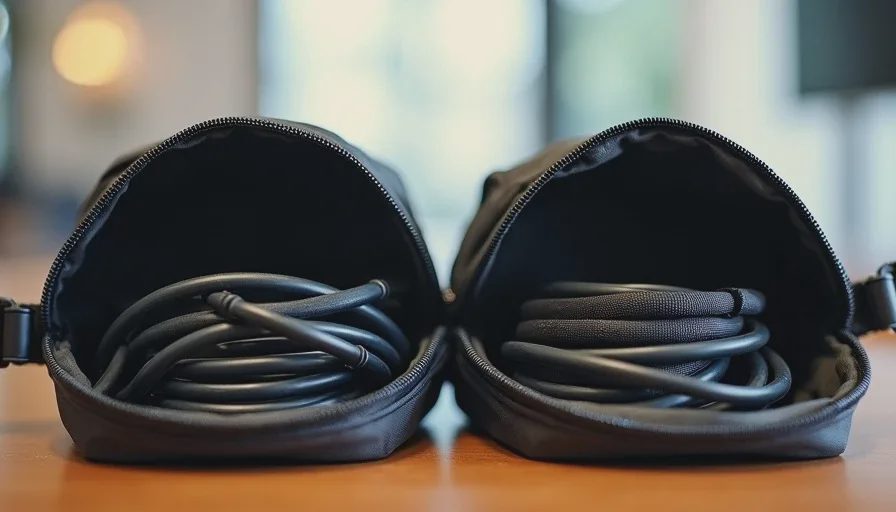
Here's what's in most people's tech pouch after six months:
Three USB-C cables, two of which are the same length
One Lightning cable for a phone they no longer own
One micro-USB cable for a device they can't identify
A dongle for a laptop they replaced
An SD card reader they've used twice
A charging brick that's too weak to charge anything they carry
A crumpled receipt
A cable tie that's no longer attached to a cable
Nobody puts these things in on purpose. They accumulate. You put a cable in "just in case." You never take it out. Then you add another one. Then the pouch is full and you stop using it because you can't find anything.
This is not a discipline problem. It's a design problem.
The Three Reasons Pouches Fail
1. The pouch has open pockets, not elastic loops. Open pockets let cables coil into a pile. Elastic loops hold each cable in place. When you open an elastic-loop pouch, you see every cable immediately. When you open an open-pocket pouch, you see a nest.
2. The pouch has no size limit. A pouch that can expand to fit more will expand to fit more. A pouch that's exactly the right size for what you need forces you to choose. The limit is the feature.
3. There's no emptying ritual. You add things. You never subtract. A pouch needs a weekly reset, or it becomes a junk drawer with a zipper.
What to Look For in a Tech Pouch
Elastic loops, not open pockets. This is the single most important feature. The Peak Design Tech Pouch ($59) and the Bellroy Tech Kit ($55) both have elastic loops that hold each cable individually. You can see everything at a glance. You know immediately if something is missing.
A flat profile. A pouch that's three inches thick will bulge in your bag and take up space you need for other things. You want something under two inches thick. The Peak Design Tech Pouch is 2.4 inches at its thickest. The Bellroy Tech Kit is 2.2 inches.
A clamshell opening. You want the pouch to open flat, like a book. Not a top-zip that makes you dig. The Peak Design opens flat. The Bellroy opens flat. Most cheap pouches don't.
A size that matches your bag. The pouch should fit in a flat front pocket of your backpack. Not the main compartment. Not strapped to the outside. A dedicated pocket. If it doesn't fit in a pocket, it'll float around your bag and you'll stop using it.
Water resistance. Not waterproof. Water resistant. You're carrying this in a bag that might get rained on. A light coating is enough. The Peak Design has a 200D nylon canvas shell with a DWR finish. The Bellroy has a water-resistant recycled woven fabric.
The Contents: What Goes In
Here's what actually belongs in a commuter tech pouch:
One 65W dual-port GaN charger. Anker 523 ($40). This replaces the laptop charger, the phone charger, and the earbuds charger. One item, three jobs.
One 10,000mAh battery pack with built-in USB-C cable. Anker 633 ($50). The built-in cable means you don't need to carry a separate one for the battery.
One 6-foot USB-C cable. For when the outlet is far away.
One 1-foot USB-C cable. For charging your phone from the battery pack while both are in your pocket.
One wireless mouse. Logitech MX Anywhere 3S ($80). Small, tracks on glass, fits in the elastic loop of most pouches.
One microfiber cloth. For cleaning your screen and glasses. Fold it flat.
One USB-A to USB-C adapter. For the one time a month you need to plug into a USB-A port. Small, flat, lives in the elastic loop.
That's seven items. That's the whole pouch.
What Doesn't Go In
Cables for devices you don't carry. If the device isn't in your bag, the cable isn't either. This is the rule that keeps the pouch from becoming a graveyard.
A second charger. You have one. It does everything. You don't need a backup.
A dongle bag. If you need HDMI, your laptop has it. If you need Ethernet, your monitor has it. If you need SD cards, your laptop has it. You don't need a bag of adapters.
A portable SSD. Unless you're editing video on the go, you don't need it. If you do, it goes in the main compartment, not the pouch.
A second mouse. You have one. It works. Don't carry a backup.
A cable you haven't used in two weeks. Take it out. If you miss it, put it back. You won't miss it.
A cable tie that isn't attached to a cable. This is how the graveyard starts. Every tie has a cable. Every cable has a tie.
The Weekly Reset
This is the ritual that keeps the pouch from filling up. It takes two minutes.
Every Sunday night, empty the pouch completely. Look at every item. Ask one question: did I use this last week?
If yes, it goes back in. If no, it stays out. If you're not sure, it stays out—if you need it this week, you'll notice and put it back.
This is the same principle as the bag reset I wrote about in the Monday office day article. It works because it's not about discipline. It's about a system that forces the decision.
The Pouch I Recommend
Peak Design Tech Pouch, $59.
It has elastic loops for cables, a clamshell opening that lays flat, a flat profile that fits in a front pocket, and a water-resistant shell. It's the pouch I've carried for two years and the one I recommend most.
Bellroy Tech Kit, $55.
Slightly smaller, slightly more refined, slightly less structured. If you carry fewer cables, this is the better choice. If you carry more, the Peak Design is better.
What I don't recommend: Any pouch under $25. The zippers fail, the elastic loses tension, and the fabric tears. You'll replace it within a year. Buy once.


No letters yet — be the first guest to write.