
Here's the short answer: one 65W dual-port GaN charger, one 10,000mAh battery pack with a built-in USB-C cable, one 6-foot USB-C cable, and one 1-foot USB-C cable. That's it. Four items, about $130 total, and it charges a laptop, a phone, and earbuds without a single dongle or a single "which cable is this" moment.
Now let me explain why this stack and not the twelve-piece kit you see in EDC photos.
The Charging Problem Nobody Solves Correctly
Most people carry too many chargers. They have a laptop charger, a phone charger, a watch charger, an earbuds cable, and a battery pack that needs its own cable. That's five items and a tangled mess.
Then they have the opposite problem: they carry one charger that's too weak to charge the laptop, so they end up plugging the laptop into a wall outlet and the phone into the charger, and the earbuds wait until they get home.
Both are wrong. The right stack is based on a simple principle: one charger that can do everything, one battery pack that can do everything, and the minimum number of cables to connect them.
Let me break down each piece.
The Charger: 65W Dual-Port GaN
Anker 523, $40.
This is the single most important item in the stack. It's a 65W charger with two USB-C ports. It's about the size of a deck of cards. It weighs almost nothing.
Here's why it matters: 65W is enough to charge a MacBook Air, a MacBook Pro 14", a ThinkPad X1 Carbon, or a Dell XPS 13 at full speed. It's not enough for a 16-inch MacBook Pro at full speed, but it will charge it slowly, which is fine if you're not in a hurry.
The dual ports mean you can charge your laptop and your phone at the same time. The charger splits power intelligently—45W to the laptop, 20W to the phone, or 30W each if both devices want more. You don't think about it. It just works.
The GaN part is why it's small. Gallium nitride chargers run cooler and take up less space than traditional silicon chargers. A 65W GaN charger is about half the size of a 65W charger from five years ago.
Why this one and not a 100W charger: A 100W charger is bigger, heavier, and more expensive. It's necessary if you have a 16-inch MacBook Pro or a gaming laptop. For most hybrid workers with a 13- or 14-inch laptop, 65W is the right size. Don't buy more charger than you need.
The one exception: If your laptop charges via USB-C and you also want to charge a tablet or a second laptop, get the Anker 727 Charging Station ($70). It's a 100W charger with two USB-C ports and two USB-A ports. It's bigger, but it covers everything.
The Battery Pack: 10,000mAh with Built-In Cable
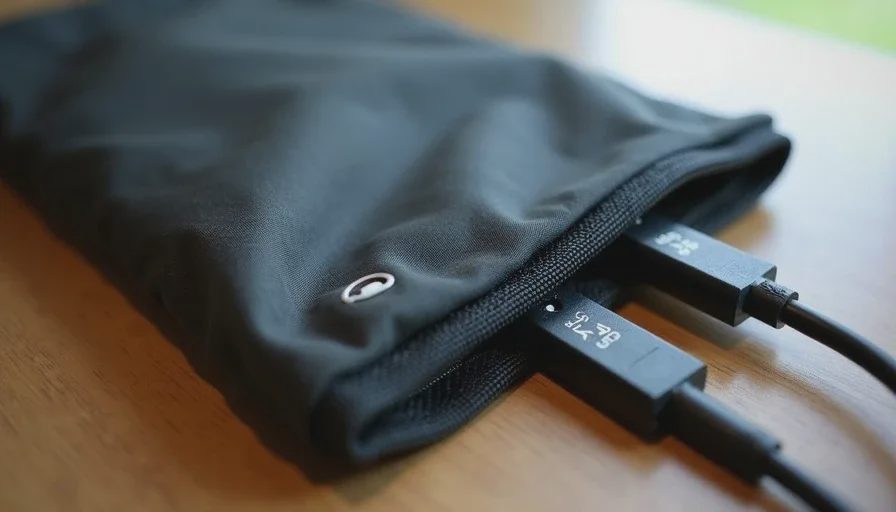
Anker 633, $50.
This is the second most important item. It's a 10,000mAh battery pack with a built-in USB-C cable. The built-in cable is the entire point.
Here's why: when your phone is at 8% and you're on a train platform, you don't want to dig through your bag for a cable. You want to pull the battery pack out of your pocket, flip out the built-in cable, and plug in your phone. One motion. No searching.
10,000mAh is enough for about two full phone charges, or one full phone charge plus a partial laptop charge. It's not enough to fully charge a laptop from empty. It's enough to get you out of an emergency.
Why not a bigger battery: A 20,000mAh battery pack is twice the size and twice the weight. It's worth it if you're traveling internationally or working off-grid. For daily commuting, 10,000mAh is the sweet spot.
Why not a smaller battery: A 5,000mAh battery pack is the size of a deck of cards. It's enough for one phone charge. It's not enough for a laptop. If you carry a laptop, you want 10,000mAh minimum.
The alternative: If you want a battery pack that can charge your laptop at full speed, get the Anker 737 Power Bank ($150). It's 24,000mAh, it can deliver 140W, and it can charge a 16-inch MacBook Pro at full speed. It's heavy—about a pound—but it's the difference between working through a delay and packing up early.
The Cables: One Long, One Short
6-foot USB-C cable, $10.**
**1-foot USB-C cable, $8.
You need two cables. Not four. Not six.
The 6-foot cable is for when the outlet is far away. This happens more than you think: the outlet behind the couch, the outlet on the far side of the café, the outlet at the airport gate that's behind the seats. A 6-foot cable means you don't have to move.
The 1-foot cable is for charging your phone from the battery pack while both are in your pocket or on the table. Short cables are underrated. A 6-foot cable coiled on a café table is a mess. A 1-foot cable is invisible.
Why USB-C for both: Your laptop charges via USB-C. Your phone charges via USB-C. Your earbuds charge via USB-C. If you have an iPhone, it charges via USB-C as of the iPhone 15. There is no reason to carry a Lightning cable in 2026.
Why not a multi-cable: Those 3-in-1 cables with interchangeable tips seem convenient. They're not. The tips get lost, the cable fails at the connector, and the charging speed is slower. Two separate cables are more reliable and take up the same space.
The one exception: If you carry a watch, you need a watch charger. The Anker 3-in-1 Cube ($150) is a charging station with a MagSafe pad, a watch charger, and a USB-C port. It's not for your bag—it's for your desk. Keep it at home and charge your watch overnight.
What I Don't Carry
A separate laptop charger. The 65W GaN charger replaces it. There is no reason to carry the brick that came with your laptop.
A separate phone charger. The same 65W charger handles it. If you need a second charger for the office, buy a second Anker 523 and leave it at your desk.
A wireless charging pad. Wireless charging is slower, less efficient, and requires a cable anyway. It's fine on a nightstand. It's useless in a bag.
A car charger. If you drive to work, charge in the car. If you take the train, you don't need one. Don't carry gear for a car you're not in.
A travel adapter. Unless you're traveling internationally this month, leave it at home. Buy one when you book the flight.
A cable for a device you don't carry. This is how bags become junk drawers. If the device isn't in the bag, the cable isn't either.
How to Pack It
Here's the exact layout in my tech pouch:
65W charger in the main compartment, left side.
Battery pack in the main compartment, right side.
6-foot cable wrapped and secured with a velcro tie, in the elastic loop at the back.
1-foot cable wrapped and secured, in the front elastic loop.
That's the whole pouch. It takes up about the space of a paperback book. It weighs about 10 ounces.
If you use the Peak Design Tech Pouch ($59) or the Bellroy Tech Kit ($55), this layout fits perfectly. If you use a generic pouch, it'll still fit—you just won't have the elastic loops to hold everything in place.
The Math
Let's add it up:
Anker 523 65W charger: $40
Anker 633 10,000mAh battery: $50
6-foot USB-C cable: $10
1-foot USB-C cable: $8
Total: $108
That's the entire charging stack for a hybrid worker carrying a laptop, a phone, and earbuds. It replaces five or six items you're probably carrying now. It weighs less than a pound. It fits in a pouch the size of a paperback.
If you want the upgraded version—faster laptop charging, more battery capacity—swap the Anker 523 for the Anker 727 ($70) and the Anker 633 for the Anker 737 ($150). Total: $238. Still less than a single first-party laptop charger and a spare battery from most brands.
What I Don't Recommend
A charger under 45W. It won't charge your laptop at a useful speed. You'll end up plugging into the wall anyway.
A battery pack without a built-in cable. You'll lose the cable. Or you'll forget it. Or it'll tangle with the other cables. Built-in is better.
A battery pack under 10,000mAh. It's one phone charge. It's not enough for a workday.
A cable longer than 6 feet. It's heavier, it's bulkier, and you don't need it. 6 feet reaches every outlet you'll encounter.
A cable shorter than 1 foot. It won't reach from the battery pack in your pocket to the phone in your hand.
Buying the cheapest cables you can find. A $3 cable will fail at the connector within six months. Spend $8–$10 on a cable from Anker, Belkin, or Cable Matters.
Carrying a charger for every device. Your laptop, phone, and earbuds all charge via USB-C. One charger handles all three.



No letters yet — be the first guest to write.