Here's the short answer: you don't need a bigger apartment. You need a directional microphone, a set of soft furnishings, a clear "headphones means do-not-disturb" rule, and a rolling cabinet that makes your work disappear at 6 p.m. Total cost: about $400. Total marriage saved: incalculable.
Now let me explain, because this is the article I wish I'd read before my wife and I spent three months silently resenting each other's keyboard clicks.
The Problem Is Almost Never the Person You Think
When couples fight about a shared home office, the conflict usually sounds like this: "You're too loud on calls," or "Your keyboard is driving me insane," or "Why are you always in my space."
Those are symptoms. The actual problem is that two people with different work styles, different noise tolerances, and different ideas about what "focused" looks like are sharing 120 square feet with no structural separation.
I've set up a lot of desks. I've watched people buy $1,500 monitors and $800 chairs, and then spend zero dollars and zero minutes solving the thing that actually makes them miserable, which is the other human being twelve feet away.
So let's fix the human problem first. The gear comes second.
The Loudest Person in the Room Is Usually the One Who Doesn't Know It
This is the first thing to address, because it's the most common and the most solvable.
When you take a call on a laptop mic, or on earbuds without a boom mic, you don't hear yourself the way your partner does. You hear your voice through your own skull. Your partner hears your voice at full volume, projected across the room, picking up every "um" and "so yeah" and "let me just share my screen."
The fix is not "talk quieter." The fix is a headset with a boom microphone that sits close enough to your mouth that you don't need to project. This came up repeatedly in advice columns about couples navigating shared workspaces—the recommendation is specifically "the kind with a microphone close enough to the mouth that he doesn't need to project so loudly".
The Logitech Zone Wireless 2 ($250) or the Jabra Evolve2 65 ($250) both do this. The boom mic sits near your mouth and rejects everything behind it. Your partner won't hear your calls. The person on the other end will hear you more clearly.
I know it looks less cool than AirPods. I know it's an extra device. Buy it anyway. This single purchase probably prevents more domestic friction than any other item in this article.
Sound Absorption: The $100 Fix Nobody Bothers With
Here's the second thing: hard surfaces make noise worse. A bare apartment with hardwood floors, drywall, and a glass coffee table is a concert hall for your spouse's voice.
The fix is soft furnishings. A heavy rug and an upholstered chair "can actually absorb a shocking amount of sound". Acoustic panels mounted on the walls and a door draft stopper "can work wonders".
You don't need to turn your living room into a recording studio. You need three things:
A rug under the work area. If your desks sit on hardwood, this is the highest-return purchase you'll make. A thick 5×7 rug is enough.
An upholstered chair instead of a hard plastic one. The fabric absorbs sound that a mesh chair reflects.
A few acoustic panels behind the person who takes the most calls. IKEA sells acoustic panels that are "an affordable, flexible solution for reducing all types of indoor and outdoor noise". Mount them on the wall behind your monitor. They don't need to cover the whole wall. Three or four panels behind the loudest speaker will make a noticeable difference.
If you're in a rental and can't mount anything, hang a thick tapestry or canvas behind the desk. It's the same principle.
Physical Boundaries: Screens, Shelves, and the Rolling Cabinet
Sound is one problem. Visual and psychological intrusion is another.
When you can see your spouse's screen and they can see yours, you're never really alone. You notice when they open Slack. You notice when they sigh at an email. You're sharing a workspace whether you want to or not.
The standard advice from design sources is to divide areas with "curtains or shelves" and to use "sound-dampening features—like rugs, acoustic panels, or strategically placed furniture" to reduce disruptions.
Here's what actually works in a small apartment:
A folding screen between the desks. A three-panel or four-panel room divider that sits between your workstations. It blocks the sightline and absorbs some sound. It doesn't need to be tall. Even a 48-inch screen makes a difference.
A bookshelf as a divider. If you have the floor space, a low bookshelf running perpendicular to the desks creates a visual wall. It also gives you storage. A bookshelf as a divider is a smart way to get "a little bit of privacy in a shared room".
A rolling cabinet for the disappearing act. This is the one that saves the evening. Put your keyboard, mouse, notebook, and headset inside a rolling cabinet at the end of the day and roll it against the wall. The desk becomes a table again. Your partner stops looking at your job.
Desk Layout: Side-by-Side Is Almost Always Better
When two people share an office, the layout matters more than the furniture.
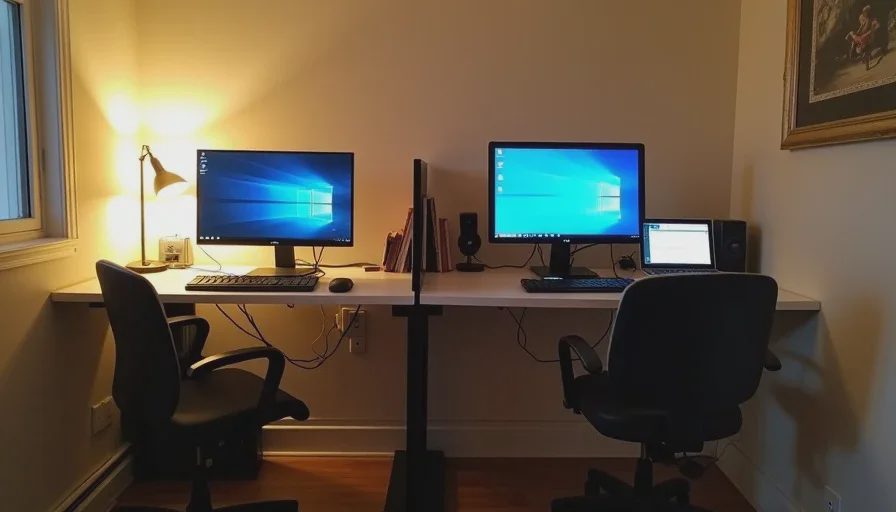
The most effective and popular solution is the side-by-side setup: two independent desks placed next to each other along a single wall. Each person has their own defined space, which is important for both productivity and focus. It also makes the room feel more open.
The face-to-face layout—two desks pushed together, partners looking at each other—works for collaboration but fails for concentration. You can't avoid eye contact. You can't avoid the distraction of someone shifting in their chair. If you have a wide room and you need to work collaboratively, it can work. If you need to focus, side-by-side is better.
One thing that's non-negotiable in a shared space: each person needs independent control over their own desk. A desk height that's perfect for someone who's 5'4" will be "painfully low" for someone who's 6'2". Two independent height-adjustable desks let each person set their own sitting and standing height without affecting the other.
The Fully Jarvis Bamboo 48" ($499) is the desk I recommend for this. Get two of them. Same frame color, same desktop material, so the room looks intentional instead of mismatched.
The Headphone Rule
In a shared office, headphones are not just audio gear. They're a social signal.
When someone is wearing headphones, it means "I'm in deep focus, do not disturb". This is a universal, wordless way to communicate without interrupting.
Agree on this rule before you need it. Agree that headphones on means don't tap the shoulder, don't ask a question, don't start a conversation about dinner. It means wait.
The Sony WH-1000XM6 ($399) is the best noise-canceling headphone for this purpose. It has the best noise canceling on the market, and cupping the right ear automatically turns down the volume so you can hear your partner without taking them off. That last feature is the one that makes it work in a shared space.
If you prefer earbuds, the AirPods Pro 3 ($249) are "about as close as earbuds get to being complete" for work-from-home use—excellent noise cancellation, strong call quality, and a transparency mode that lets you hear your partner when you need to.
The Calendar Problem
Here's the one that nobody talks about until it's too late.
You have a call at 10 a.m. Your spouse also has a call at 10 a.m. Neither of you knew about the other's call. Now you're both talking at the same time, and neither of you can hear your own meeting.
The fix is embarrassingly simple: share your calendars every morning. Over coffee, look at each other's day. Move the calls that overlap. If you can't move them, decide who takes theirs in the bedroom or the kitchen.
The scheduling conflict is the most predictable source of shared-office friction, and it's the easiest to prevent. One five-minute conversation in the morning saves an hour of mutual annoyance in the afternoon.
What I Don't Recommend
Buying a bigger apartment for this. You can solve 90% of the problem for $400. Don't move.
Assuming your spouse will "just deal with it." They won't. They'll resent it. Then they'll resent you.
A shared single desk. One large table sounds romantic. It isn't. You'll fight over the outlet and the armrest.
Acoustic foam on every wall. It looks like a dorm room, it's expensive, and three panels behind the loudest speaker will get you most of the way there.
Silent keyboards. They don't exist. Buy a boom mic instead.
Noise-canceling headphones for both people. ANC helps the person wearing it. It does nothing for the person sitting next to them. The boom mic helps the person sitting next to you.



No letters yet — be the first guest to write.